
Shortly after midnight on December 16, 1943, the Atlantic Coast Line southbound train left Fayetteville, North Carolina, behind schedule, pulling eighteen cars into the early morning hours. The trip was uneventful until the train approached Rennert, where a sudden jolt caused the last three cars to uncouple. While the cars remained upright, the dining car and Pullman sleeper came to a stop, partially blocking the northbound track.
The engineer felt the emergency brakes engage, and the train came to a stop about half a mile beyond where the cars had separated. In the rear, the brakeman quickly helped passengers out of the affected cars and used a signal light to alert the rest of the crew to the separation.
While investigating, the engineers discovered a broken coupler, but were not immediately aware of the whole situation behind it. The conductor, seeing a distant signal light, mistakenly thought it was simply a lost lantern and did not realize the seriousness of the incident.
The flagman attempted to warn any oncoming trains by lighting a flare, but slippery conditions caused him to fall, and the warning was not seen. Meanwhile, a northbound train approached at high speed. The engineer noticed the commotion and attempted to stop, but there was not enough time to avoid a collision.
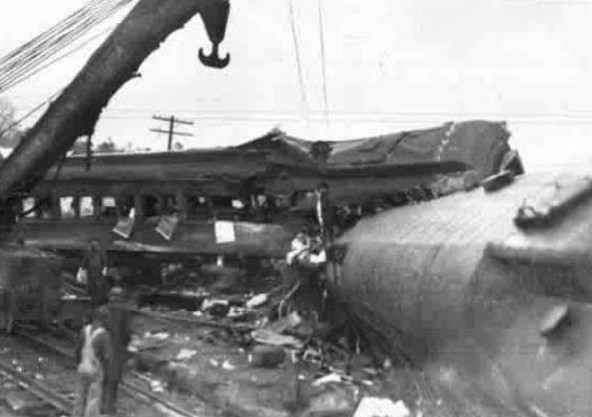
The resulting crash was severe. Passenger cars, many carrying service members on leave for the holidays, were heavily damaged. Seventy-four people died, including fifty-one soldiers and one southbound passenger. The scene was described as a tangle of twisted rails and wrecked train cars.
It remains the deadliest train wreck in North Carolina’s history.
The cause: The initial derailment was caused by a rail breaking beneath the train
Written by John G. Clark Jr.