

Greenville’s downtown is a bustling hub today, filled with visitors flocking to Main Street’s lively shops, diverse eateries, and the iconic Liberty Bridge in Falls Park. Yet, beneath this modern vibrancy lies a history that’s seldom discussed—one woven with stories of haunts and hidden pasts. Long before the city’s present-day charm, this land was once the hunting grounds of the Cherokee. It wasn’t until around 1770 that the first settler of Western origin made a home here, marking the beginning of Greenville’s transformation.
The arrival of Furman University in the 1850s and the extension of the railroad to connect with Columbia spurred Greenville’s early growth. However, the city’s true boom came with the rise of the textile industry in the South. Old mills, some dating back to around 1876—just a decade after the Civil War—once powered Greenville’s prosperity and have since been converted into modern apartments. Even now, the city’s landscape is dotted with these historic structures, standing as silent witnesses to a bygone era.
But Greenville’s story isn’t just one of progress and charm. Like many Southern towns, it had its share of shadows—an underworld marked by debauchery, tragedy, and events that still echo through its historic streets.
In this series, I’ll be exploring many of these locations, including the historic textile mills that have shaped Greenville’s past. While I haven’t written extensively about them before, these mills were places where danger and tragedy often lurked. Emerging in the years after the Civil War, they provided families with economic opportunity and forged new communities known as mill hills.
Life in the mills was far from idyllic. Workers faced harsh and hazardous conditions, mounting debts that seemed impossible to escape, and child labor was all too common. It’s no wonder that many former mills—now transformed into modern housing—are rumored to be haunted. The mysterious bump in the night may not be a neighbor at all, but perhaps the lingering presence of someone who once toiled within those walls, still working from the spirit world.
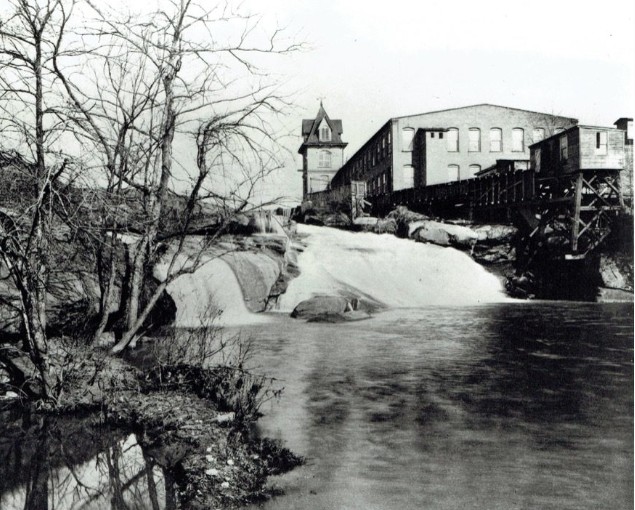
Reedy Falls is yet another location in Greenville with a ghostly legacy. Once, the grounds were home to Chicora College, stretching from Camperdown Street to River Street. In 1904, a local newspaper reported that a down-on-his-luck gentleman, formerly in the financial industry, had allegedly leapt from a window on the college campus. Thanks to the resources in the South Carolina Room at Greenville’s main library branch, I was able to uncover this article.
Locals dubbed the mysterious presence the Chicora College Ghost. Beyond this single report, however, little is known, and the story remains shrouded in mystery. The college moved from Greenville to Columbia sometime around 1916.
Boggs Street, nestled in Downtown Greenville, South Carolina, is the site of one of the city’s more chilling legends. Numerous witnesses have reported seeing the apparition of a lost-looking man wandering toward them, his presence unsettling in the quiet night. This story appears in several sources, including Jason Profit’s “Haunted Greenville, South Carolina.”
The tale centers around the area behind 640 South Main Street, where two brick warehouses once stood—one serving as a tombstone manufacturer. According to legend, every tombstone crafted there reached its intended grave except for one, which sat abandoned on the side of Boggs Street for years. During this time, passersby claimed to see the ghostly figure of a man lingering nearby, and the sight of the forgotten tombstone sent chills down many people’s spines.
Eventually, the tombstone was moved, and some locals hoped that the restless spirit had finally found peace. Yet, the mystery persists. Jason Profit recounts that during his 2010 ghost tour, attendees reported seeing orbs appear around him as he narrated the story to captivated crowds.
Jason Profit’s book delves into many of Greenville’s historic buildings—some of which may surprise you. From a haunted pizza shop to the apparition of a man descending stairs in a former boutique, the city’s spectral tales are as diverse as its architecture.
For more stories about Greenville’s haunted history, visit our website.
Written by John G. Clark Jr.